Inhotim

Introduction
The Instituto Inhotim, located in Brumadinho, in the state of Minas Gerais, Brazil, is a truly extraordinary destination that unites contemporary art and botanical splendour. Set approximately sixty kilometres from the city of Belo Horizonte, this vibrant living museum enchants visitors with its harmonious marriage of art, lush landscapes, and refined architecture. Whether you are a lover of art or a nature enthusiast, Inhotim offers a uniquely immersive experience that invites reflection, discovery, and delight.


About the Museum
The Instituto Inhotim is a non‑profit private institution, officially recognized as a Civil Society Organization of Public Interest by the Government of Minas Gerais. It was envisioned by entrepreneur Bernardo de Mello Paz and opened to the public in 2006. Situated amidst the rich biomes of the Atlantic Forest and the Cerrado, the institution spans approximately one hundred and forty hectares of visiting area, combining forest remnants, themed gardens, and art pavilions in a seamless natural setting.
The Institute houses an extensive contemporary art collection of over thirteen hundred works created by more than one hundred renowned artists from around thirty countries. Approximately five hundred pieces are currently on display, both outdoors and within its galleries. The museum consists of twenty‑three distinct pavilions, including four dedicated to temporary exhibitions—named the Lago, Fonte, Praça and Mata galleries—and nineteen permanent galleries built for artist‑specific works.
Art installations are deeply integrated into the landscape. Among the remarkable works are Matthew Barney’s “De Lama Lâmina” installed within a geodesic dome, Chris Burden’s monumental Beam Drop, Doug Aitken’s meditative Sonic Pavilion, Cristina Iglesias’s reflective Vegetation Room, and Yayoi Kusama’s iconic Narcissus Garden, reimagined for Inhotim. The collection also showcases works by artists such as Hélio Oiticica, Doris Salcedo, Rivane Neuenschwander, Anish Kapoor, Olafur Eliasson, Robert Irwin, Steve McQueen, Thomas Hirschhorn, Lygia Pape, and Claudia Andujar.
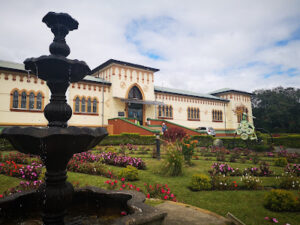
On the botanical side, Inhotim is officially recognized as a botanical garden by the Brazilian national authority, featuring nearly five thousand species of rare flora. The most notable collections include over one thousand species of palm trees (family Arecaceae) and more than four hundred varieties of Philodendron, Anthurium, and Calla Lily (family Araceae). The gardens are thoughtfully designed, with pathways, patios, lakes, and natural rock formations that blend with the rich landscape.
Visitors can also enjoy a variety of gastronomic offerings. The Inhotim Restaurant features an inviting setting among the gardens and art collections, offering a varied salad bar, à‑la‑carte dishes, a wide wine selection, and desserts. The Bar do Ganso provides international cuisine in a space curated by designer Paulo Henrique Bicalho, offering appetizers and light snacks. The Café do Teatro—a cozy café located in the education and culture centre—serves specialty coffees, beverages, snacks, and sweets. Other options include the pay‑by‑weight buffet at the Oiticica Restaurant, as well as a pizzeria, a hot‑dog stand, and snack bars in several gallery areas.
Interesting Facts
- The name Inhotim derives from the local pronunciation of “Nhô Tim”, referring to an English engineer named Mr. Tim who formerly owned the farm on which the Institute now stands.
- The Institute is one of the largest open‑air art museums in the world and stands out as the largest outdoor collection of contemporary art in Latin America.
- It holds nearly five thousand botanical species, including more than one thousand types of palms and over four hundred Araceae species—one of the largest such collections globally.
- Inhotim is the only location in Latin America to house the carrion flower (also known as the corpse flower), famed for its massive size and pungent scent. It bloomed for the first time on December 15, 2010, and again on December 27, 2012.
- The Sonic Pavilion includes a two‑hundred‑meter‑deep well lined with microphones that pick up subterranean sounds, which are then played live within the pavilion, creating an immersive auditory experience.
Photo Gallery


Physical Location
Contact Details
Phone: +55 31 3571-9700
Website: inhotim.org.br/
Facebook: facebook.com/inhotim/
Conclusion
The Instituto Inhotim is a remarkable invitation to journey through the fusion of contemporary art and natural splendor. Here, art does not merely reside in buildings—it emerges from the earth, resonates with the forest, and dialogues with rare tropical flora. Each gallery and pathway offers an immersive encounter with creativity meticulously woven into the landscape.
For those planning a visit, dedicating at least one full day—and ideally two—ensures the chance to savour both the art and the gardens fully. Whether walking among monumental installations, discovering delicate blooms, or pausing for a thoughtfully prepared meal in a verdant setting, visitors are bound to leave with their senses enlivened and their curiosity awakened.
The Instituto Inhotim stands as a testament to the transformative power of art and nature united. It is more than a museum—it is a living masterpiece that celebrates diversity, inspires wonder, and offers an unforgettable experience for all who walk its paths.